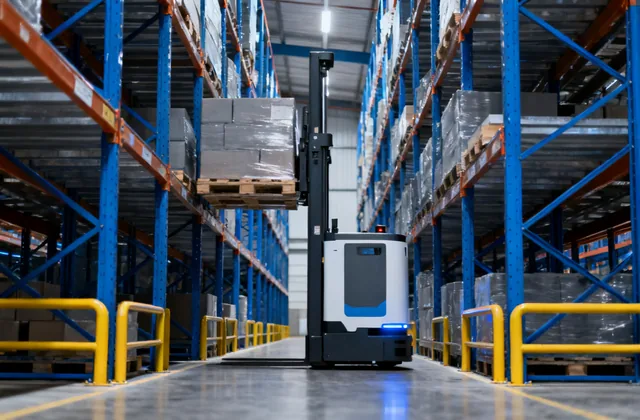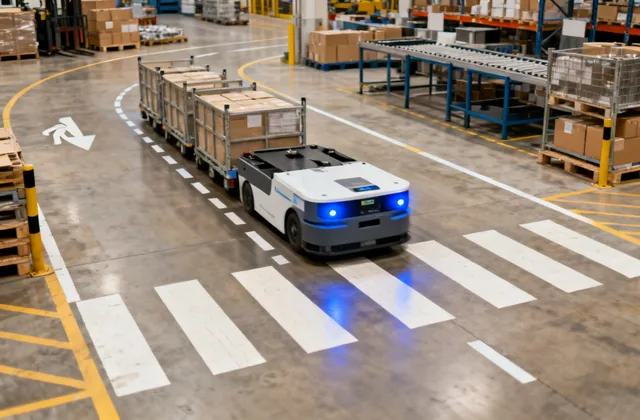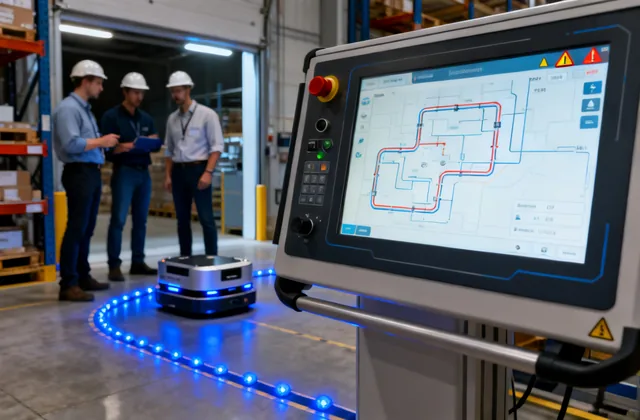

Seegrid vision-guided AMR fleet in a warehouse automation cell with racking, conveyors and safety scan zones
AGV · AMR · fleet evidence

Seegrid robotics sized from operating evidence

Translate load units, peak windows, SLAM navigation corridors, fleet management system handshakes and exception recovery into requirements your operations, controls and EHS reviewers can inspect before fleet size hardens.

Fleet safetyScanner fields, traffic rules, charging and exception handling stated as testable requirements
Controls matrixWMS, WCS, WES, PLC and FMS ownership mapped for commands, timeouts and alarms
Throughput proofRate validated against SKU mix, order profile, peak duration and buffer occupancy
Phased cutoverLive waves protected with fallback states, commissioning windows and acceptance gates
Specification review tabs

Compare Seegrid evaluation layers without mixing evidence classes

Each tab isolates one decision layer so fleet rate, interface ownership and site constraints stay separable during technical review.

ParameterWhat to freezeWhy it changes fleet size
Load unitMass, footprint, underside, center of gravityAffects stability, fork or deck choice and stop distances
Aisle geometryClear width, turning envelope, doors, floor jointsConstrains vision corridors and simultaneous traffic
Human interactionCrossings, restricted zones, manual intervention pointsSets scanner fields and priority rules
ParameterWhat to freezeWhy it changes fleet size
SKU velocityBands and replenishment competitionChanges travel concentration and charging windows
Order lines / hourAverage versus sustained peak windowSeparates short bursts from design-rate claims
Buffer occupancyQueue capacity at pickup and dropPrevents starvation and blocking from being hidden
LayerOwnership questionEvidence artifact
WMS / WESWho releases work and closes inventory state?Message list with timeouts
WCS / PLCWho owns local traffic, conveyors and cell interlocking?Handshake and alarm matrix
Fleet managerWho assigns missions, charging and recovery?FMS exception playbook
GateTest boundaryDeliverable
Design rateSKU mix, peak duration (often 60–120 minutes), replenishmentScenario and sensitivity record
FATAgreed behaviors, safety laser scanner fields and interface scriptFactory acceptance evidence
SATInstalled floor, wireless coverage and host conditionsSite acceptance checklist with recovery cases
Operating-profile matrix

Compare warehouse verticals that rewrite Seegrid fleet assumptions

SKU depth, peak factor, temperature and pallet/tote mix must travel together. Mobile cards keep the same fields when the matrix collapses.

Vertical SKU depth Peak factor Temperature Load-unit mix
E-commerce fulfillment Very high Promotion waves Ambient Tote / carton heavy
Grocery distribution High Store cutoffs Ambient + chilled Case / roll cage
Cold chain Medium-high Door-window limited Chilled / frozen Pallet dominant
Manufacturing staging Medium Takt spikes Ambient Pallet / tote mixed
3PL multi-client Variable Client-driven Mixed zones Heterogeneous

E-commerce fulfillment

SKU depth: Very high
Peak factor: Promotion waves
Temperature: Ambient
Load-unit mix: Tote / carton heavy

Grocery distribution

SKU depth: High
Peak factor: Store cutoffs
Temperature: Ambient + chilled
Load-unit mix: Case / roll cage

Cold chain

SKU depth: Medium-high
Peak factor: Door-window limited
Temperature: Chilled / frozen
Load-unit mix: Pallet dominant

Manufacturing staging

SKU depth: Medium
Peak factor: Takt spikes
Temperature: Ambient
Load-unit mix: Pallet / tote mixed

3PL multi-client

SKU depth: Variable
Peak factor: Client-driven
Temperature: Mixed zones
Load-unit mix: Heterogeneous

Open detailed operating profiles →

Selection trade-off (B-class conservative): Fixed automation can deliver higher deterministic capacity for stable SKU mixes, while flexible AMR/AGV fleets favor phased brownfield cutover and layout change. Peak units/hour claims conflict with buffer occupancy and exception recovery unless both design-rate and resilient-flow cases are logged. Seegrid does not publish unnamed competitor benchmarks; the review freezes aisle width in mm, rated load in kg, interface cycle time in seconds and system availability % before fleet size hardens.
Engineering RFQ

Bring the SKU mix, peak window and control boundaries into one brief

Share measurable application inputs so Seegrid engineering can separate design facts from assumptions that still need site evidence.