Identity before movement
Grocery and cold-chain sites may require condition or lot checks before a pallet becomes available to an AMR mission under Seegrid traffic rules.
An industry name does not specify a viable automation design. We translate vertical context into SKU depth, order release, load unit, temperature, labor interaction, peak factor and exception cases before comparing vision-guided AMR or AGV concepts for Seegrid programs.
Distribution, manufacturing and multi-client 3PL sites often share the same robot chassis while demanding different traffic rules, charging policies and host ownership. The operating profile is therefore the first artifact, not a brochure afterthought, when Seegrid engineering sizes a fleet.
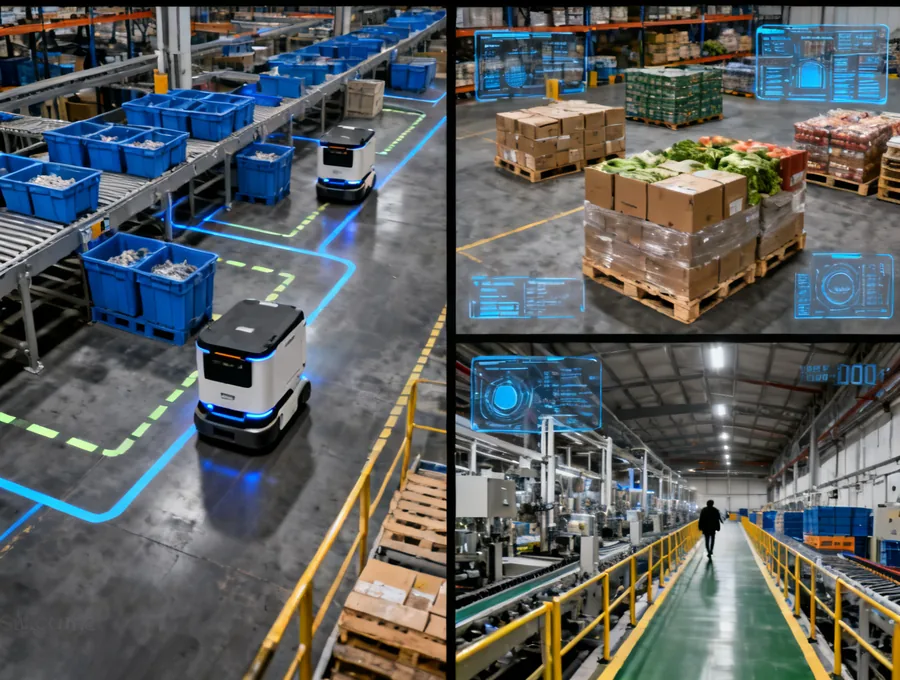
These profiles frame discovery questions for Seegrid evaluations. Values remain project inputs, and no capacity claim should be inferred before demand files, layout and exception logic are tested.
| Vertical | SKU and demand shape | Load-unit mix | Peak and environment | Design emphasis |
|---|---|---|---|---|
| E-commerce | Deep SKU range, small orders, cutoff-driven waves and promotions. | Totes, cartons, mobile racks and occasional pallets. | Short high peaks; ambient zones with dense human interaction. | Station balance, congestion control and backlog clearance. |
| Grocery | Store sequences, freshness windows and replenishment-driven demand. | Pallets, roll cages, totes and mixed-case handling. | Temperature zones and time-sensitive dispatch windows. | Zone transitions, battery performance and sequence integrity. |
| Cold chain | Variable inventory velocity inside temperature-separated zones. | Pallet and tote formats affected by condensation or frost. | Low-temperature duty affects battery, sensors and human access. | Environmental limits, warm-up practice and recovery access. |
| Manufacturing | Consumption linked to takt, work orders and component call-offs. | Pallets, carts, bins and returnable containers. | Stable cadence with high consequence for missed line delivery. | Priority logic, line-side handshake and manual fallback. |
| 3PL multi-client | Client-driven waves with heterogeneous SLAs and shared aisles. | Mixed pallet, tote and carton formats by client contract. | Zone contention and charge windows change with client mix. | Segregation rules, mission priority and exception ownership. |
Instead of assigning one technology label to an entire building, the review locates the handoff where identity, timing or physical control is most exposed.
Grocery and cold-chain sites may require condition or lot checks before a pallet becomes available to an AMR mission under Seegrid traffic rules.
Dense storage reduces travel and footprint for suitable inventory, while direct selectivity protects access, maintenance isolation and SKU flexibility.
Mission rate must include crossing delays, pickup tolerance, battery policy, route blocks and the effect of a disabled robot on alternate paths.
A workcell, operator or conveyor needs a defined ready state, physical capacity and timeout response before a robot is dispatched.
Fault isolation, manual bypass and backlog clearance determine whether a local incident remains local or propagates across fulfillment.
Operational resilience can conflict with a design optimized only for peak rate. Buffers, alternate routes and manual interventions may reduce theoretical output while protecting stable fulfillment during disturbances that Seegrid fleets will face after go-live.
Fixed automation can provide deterministic capacity when flow is stable. Flexible robotics can support phased deployment and layout changes, but fleet traffic and charging introduce their own dependencies. The correct balance depends on forecast confidence, change frequency and recovery expectations documented with the Seegrid project team.
Controls architecture is a second trade-off: a centralized WCS/WES can optimize global mission release and one operational view, while modular controls can isolate failures and reduce single-vendor dependency. Seegrid evaluations state which model owns timeouts, alarms and restart authority before interface cycle time in seconds is frozen.
Define whether the robot waits, diverts, returns the load or escalates—and which layer owns that decision.
Prevent physical movement from outrunning WMS or WCS state when a label, scan or confirmation fails.
State safe behavior, local stopping response, retained mission data and controlled restart sequence.
Measure how release logic changes, where backlog accumulates and how long normal flow takes to recover.
Three demand views reveal more than an annual average for a Seegrid operating-profile review. Attach order-line or mission distributions, load-unit families, shift calendars, cutoffs, replenishment behavior and the exceptions operations considers unacceptable.